Too Many Shows, Too Little Time: How Infinite Choice Broke the Way We Watch
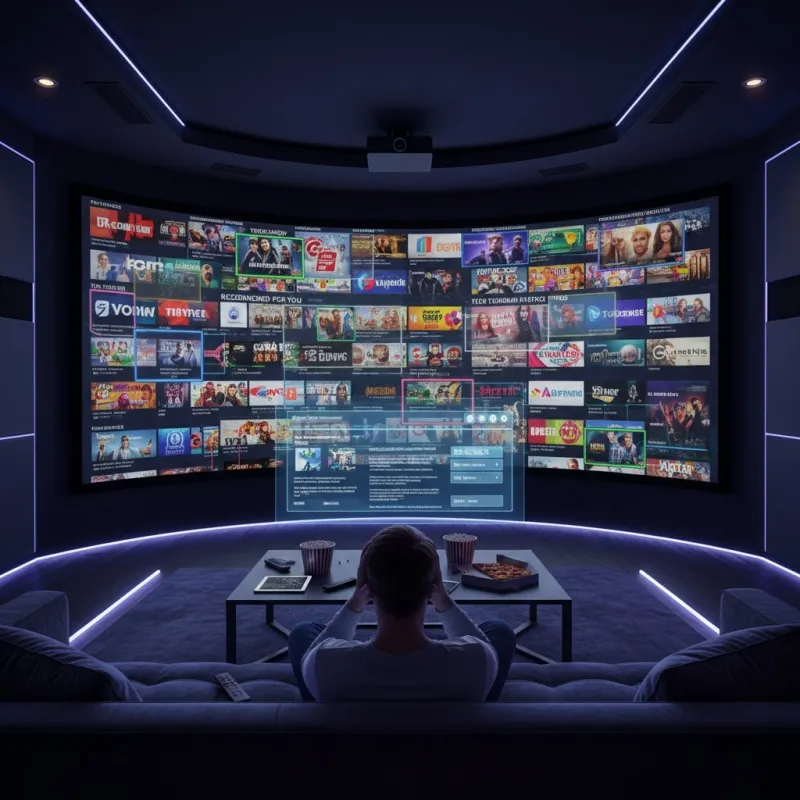
Photo: person overwhelmed looking at TV streaming options remote control couch, via obrazki.ai
Remember when picking something to watch on a Friday night was easy? You flipped through a handful of channels, landed on something decent, and that was that. Now you've got eight streaming subscriptions, a combined library of tens of thousands of titles, and somehow — somehow — you spend forty-five minutes scrolling before giving up and rewatching The Office for the fourth time.
You're not alone. And you're not lazy. You're experiencing what researchers call choice overload, and streaming platforms built the exact conditions for it to thrive.
The Numbers Don't Lie (But They're Embarrassing)
A 2023 survey by Whip Media found that American viewers spend an average of 17.8 minutes per session just deciding what to watch — before a single frame of actual content plays. Nielsen data from the same period clocked the average US household cycling through more than 1,300 titles before making a selection on any given evening. That's not browsing. That's a second job.
And the content libraries feeding that scroll? They're massive. Netflix alone has crossed the 17,000-title threshold in the US market. Add in the catalogs from Max, Peacock, Disney+, Hulu, Apple TV+, Paramount+, and Amazon Prime Video, and a fully subscribed American household theoretically has access to somewhere in the neighborhood of 60,000 hours of content. You could watch continuously for nearly seven years without repeating a single title.
So why does it feel like there's nothing on?
When More Becomes Less
Psychologist Barry Schwartz laid out the theoretical groundwork for this problem in his 2004 book The Paradox of Choice, arguing that expanding options doesn't increase satisfaction — it increases anxiety. The more choices you have, the higher your expectations climb, and the harder it becomes to feel good about whatever you ultimately pick. You're always wondering if the better show is just one more scroll away.
Streaming platforms essentially industrialized this effect. Every new original series added to a catalog is, in theory, a competitive advantage. More content means more reasons to subscribe, more value propositions, more marketing hooks. But from a viewer experience standpoint, each new addition also increases the cognitive load of simply sitting down to be entertained.
"There's a threshold where abundance stops feeling like a gift and starts feeling like homework," says one UX designer who has consulted for multiple major streaming services. "When users feel overwhelmed, their default behavior is avoidance or regression — they fall back on familiar content rather than engaging with anything new."
That regression pattern is a quiet crisis for platforms that have sunk billions into original programming. What's the point of a prestige limited series if viewers never make it past the thumbnail?
The Algorithm's Dirty Secret
Here's the irony that streaming executives don't love talking about: the personalization algorithms that platforms market as solutions to choice overload often make the problem worse.
Recommendation engines are trained on past behavior, which means they're constantly nudging you toward things you already know you like. That sounds helpful until you realize it creates a feedback loop — a kind of content echo chamber where genuinely surprising or adventurous programming gets buried under an avalanche of "because you watched" suggestions that all look suspiciously similar.
The algorithm optimizes for the click, not for the experience. A thumbnail that gets you to press play counts as a win, regardless of whether you finish the show or feel good about the time you spent. Platforms measure engagement in terms of starts, not satisfaction — and those two things aren't the same.
Some internal testing at major platforms has reportedly shown that users who are served highly personalized recommendation feeds actually explore less of the overall catalog than users who encounter more editorially curated or even randomized suggestions. The algorithm designed to help you find your next favorite show might be the exact thing keeping you from it.
How Platforms Are Trying to Dig Out
The industry isn't blind to the problem. Over the past couple of years, several platforms have quietly begun experimenting with curation-first approaches that deliberately limit the scope of what you see at any given moment.
Netflix has tested a "Play Something" feature — essentially a shuffle button — that removes the decision entirely and just starts something based on your history. It's a blunt instrument, but early data suggested it meaningfully reduced session abandonment rates among users who were stuck in scroll loops.
Apple TV+ has leaned into a small, tightly curated library as a brand identity rather than a weakness. With a catalog a fraction of the size of its competitors, Apple bets that the reduced overwhelm translates into higher per-title engagement. Whether that strategy scales long-term is an open question, but it represents a genuine philosophical counterpoint to the "more is more" arms race.
Some platforms are also revisiting the idea of editorial voice — actual human curation, themed collections, staff picks, and contextual programming that mirrors what made HBO's reputation in the cable era. The pitch is simple: trust us, we've done the work, just watch this.
"Viewers don't actually want infinite choice," says another UX researcher who worked on interface design for a major US streaming service. "They want to feel like someone they trust already vetted the options and handed them something good. That's what appointment television used to provide. Streaming took it away and called it freedom."
The Rewatch Economy
Maybe the most telling symptom of choice overload is what viewers actually do when the scroll becomes unbearable: they rewatch things they've already seen.
Parrot Analytics data consistently shows that library titles — older shows and films that audiences already have a relationship with — outperform new originals in total viewing hours across most platforms. The comfort of the known beats the anxiety of the new. And platforms have increasingly leaned into this reality, licensing back catalog content and positioning familiarity as a feature.
For original content creators, that's a sobering reality. Your brand-new, carefully crafted series is competing not just with every other new show on every other platform — it's competing with a viewer's desire to just put on something they know won't disappoint them.
What Actually Fixes This
The honest answer is that there's no clean solution, because the problem is structural. Streaming platforms are businesses, and content volume drives subscriber acquisition. Shrinking catalogs isn't something Wall Street rewards. But the platforms that figure out how to make their libraries feel navigable — not just large — are the ones most likely to retain viewers who are increasingly aware of how much time they're burning just trying to decide.
Better curation. Smarter interfaces. Features that reward finishing a show rather than just starting one. These aren't glamorous innovations, but they're the ones that actually address what's driving viewers to the couch and then straight back off it.
The streaming wars were always marketed as a competition over content. Turns out the real battleground might just be your attention span — and right now, the scroll is winning.